A Level Economics · Edexcel A level Economics A (9EC0), Theme 3
Orrelby Market Square: perfect and monopolistic competition
A Saturday market with potato growers on one side and coffee stalls on the other. Two market structures compared with figures and diagrams.
- 3 lessons of about 55 minutes
- 24-page student workbook
- 15-page teacher guide
- PDF and editable Word
- Teacher guide with full worked answers
- Checked page by page and recalculated before release
Digital download. By buying you ask for immediate access to the files and acknowledge that you then lose the 14-day right to cancel. Refunds: see our refund page.
Free sample (PDF): cover, contents and the first two pages of Lesson 1. No answers, no email needed.
Read the video text
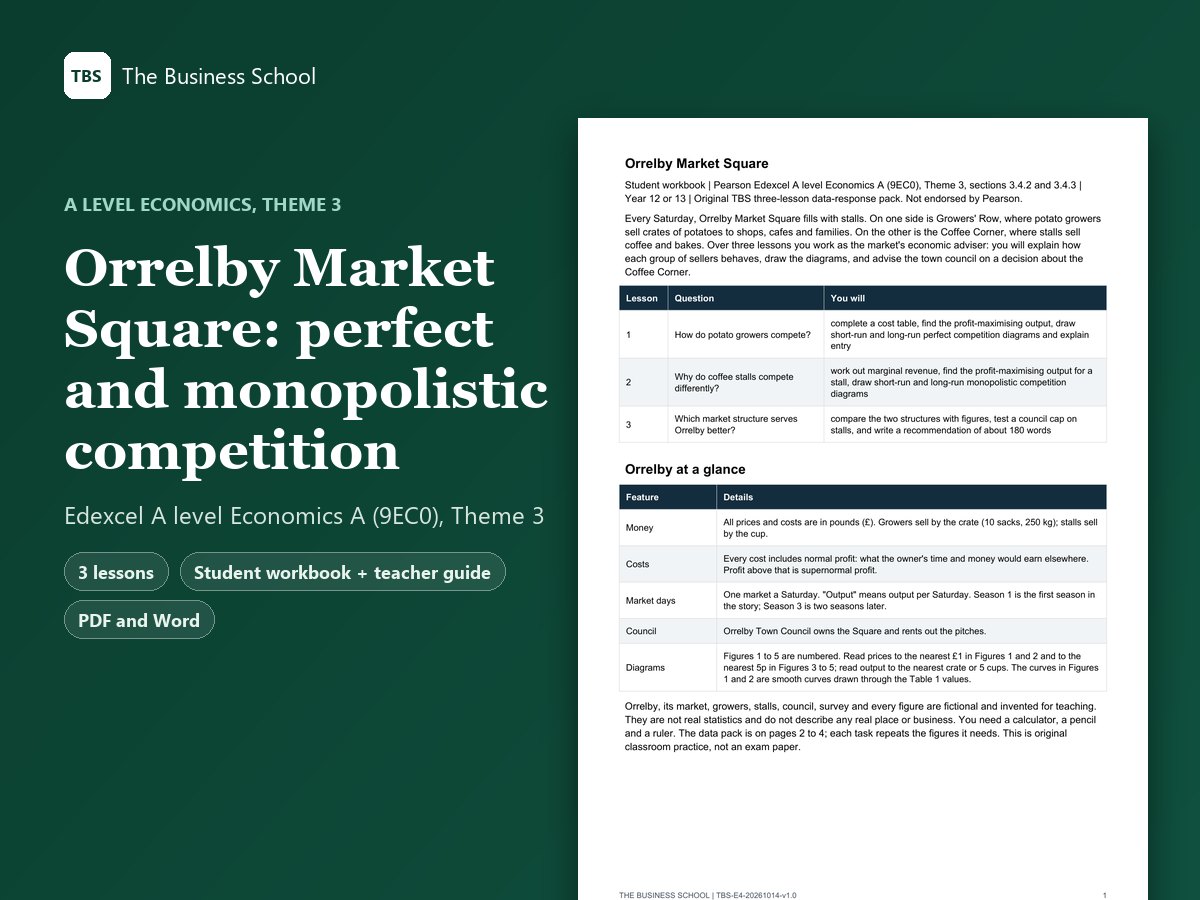
Orrelby Market Square: two market structures. Edexcel A level Economics (9EC0), Theme 3. Choose the output and the profit. Lesson 1: How do potato growers compete?. Calculate marginal revenue and profit. Lesson 2: Why do coffee stalls compete differently?. See what ten stalls do to profit. Season 3: demand, average cost and marginal cost. Compare the two structures. Lesson 3: Which market structure serves Orrelby better?. Draw the diagram. Test the council cap, then check the completed diagram. Write a recommendation. Check it against the checklist. What you get: Student workbook + teacher guide, Full worked answers, PDF and editable Word. The Business School. Free sample on the pack page.
What is inside
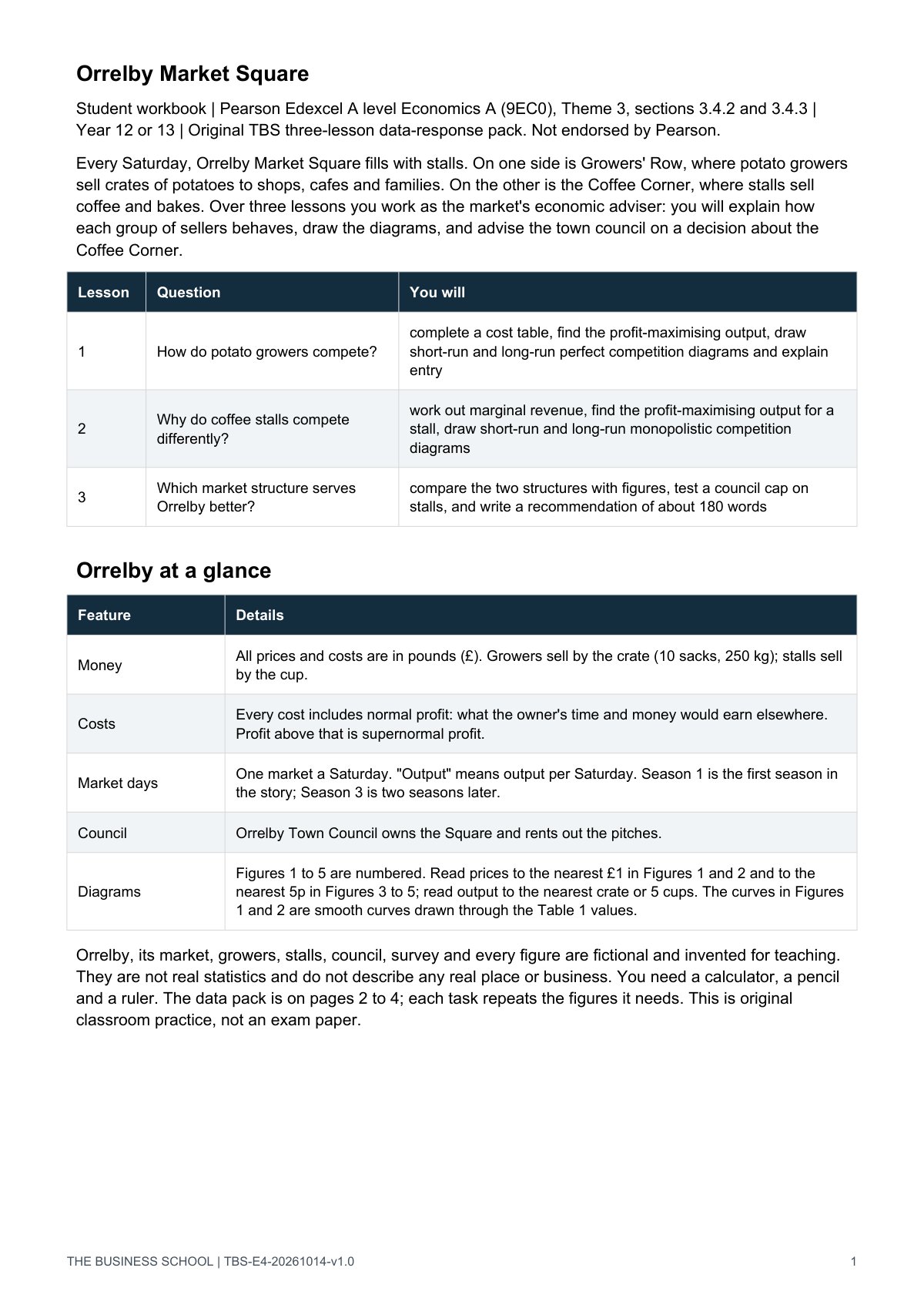
One original, fictional market for three lessons of about 55 minutes with Year 12 or 13. Students work from a three-page data pack.
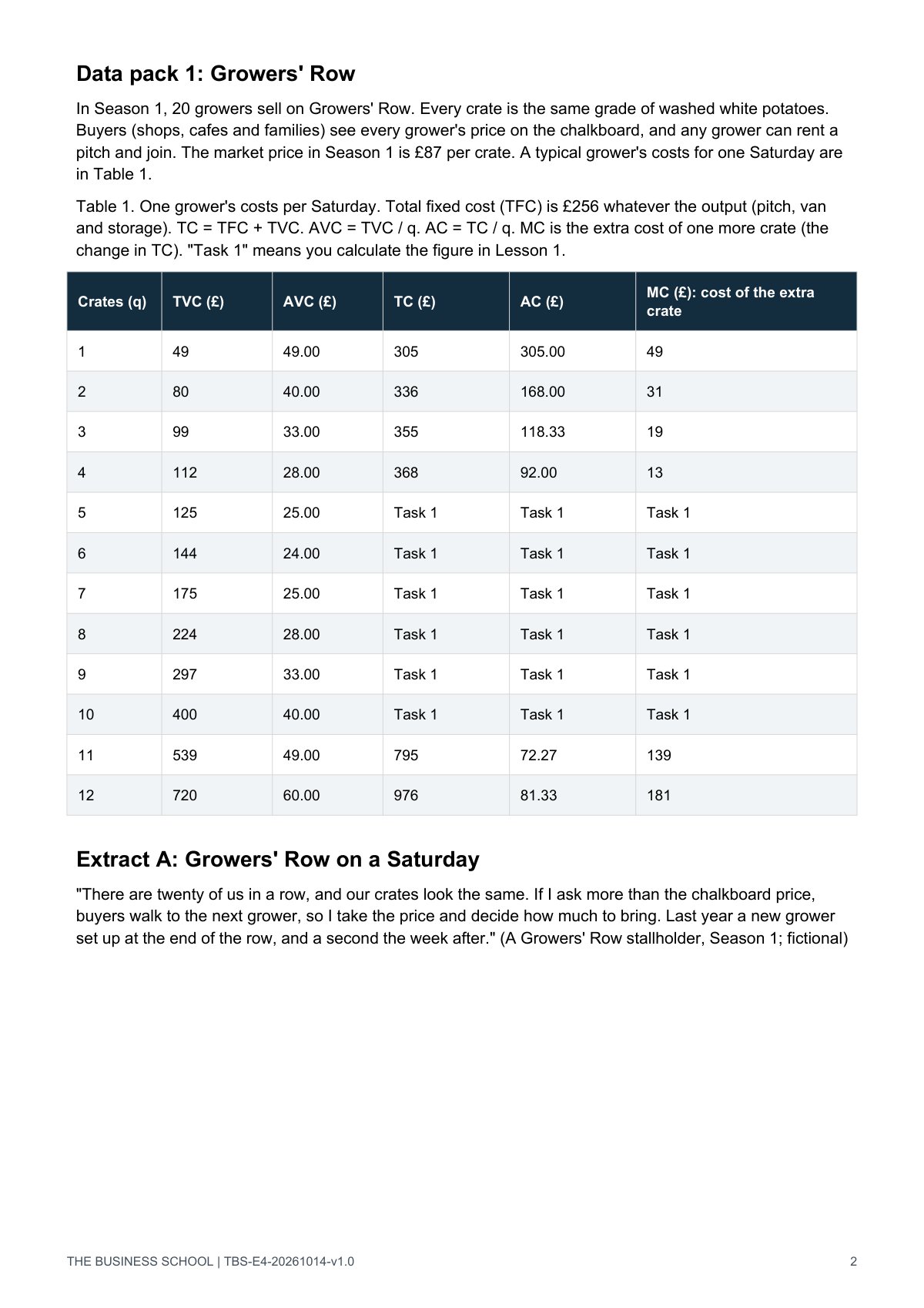
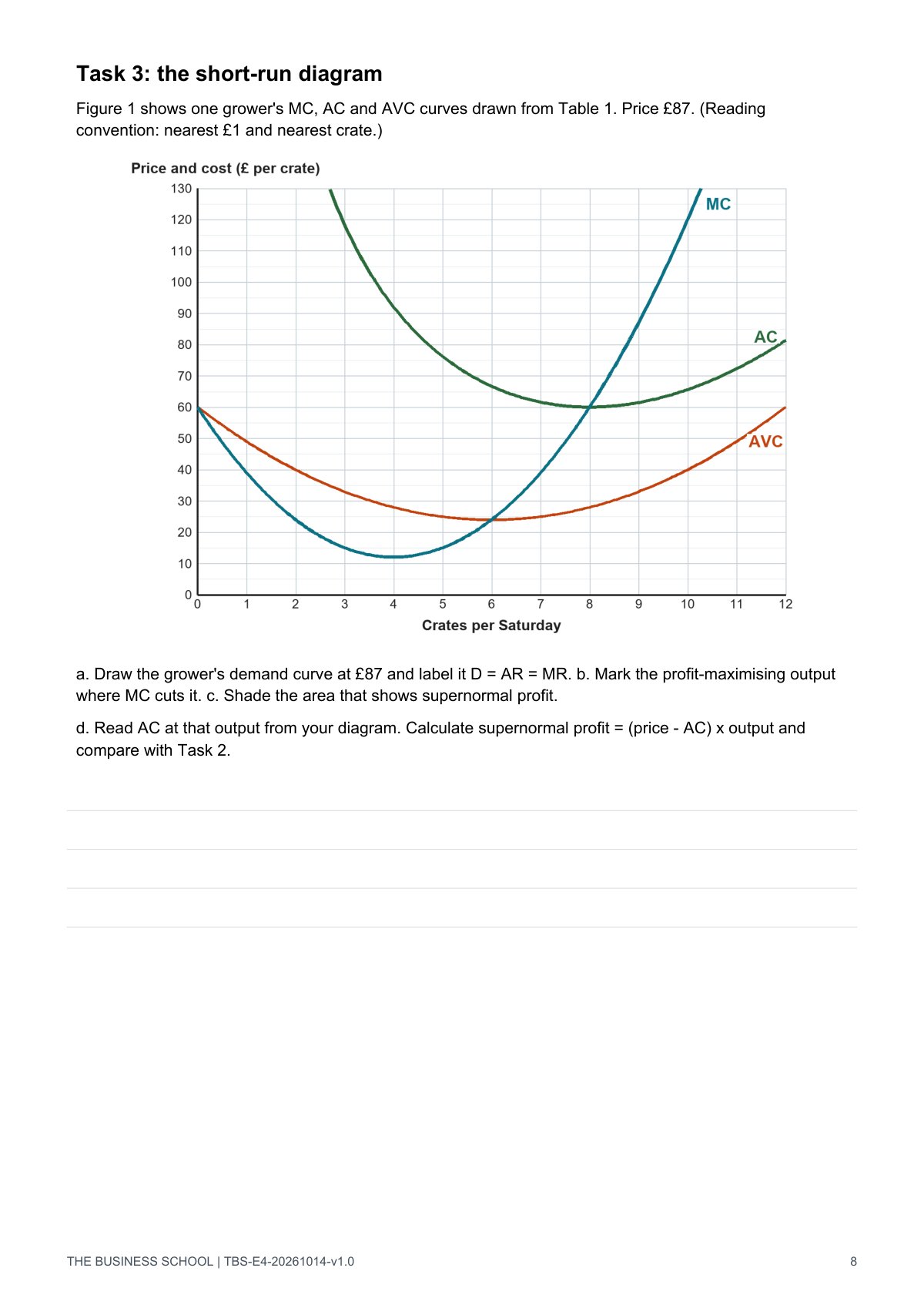
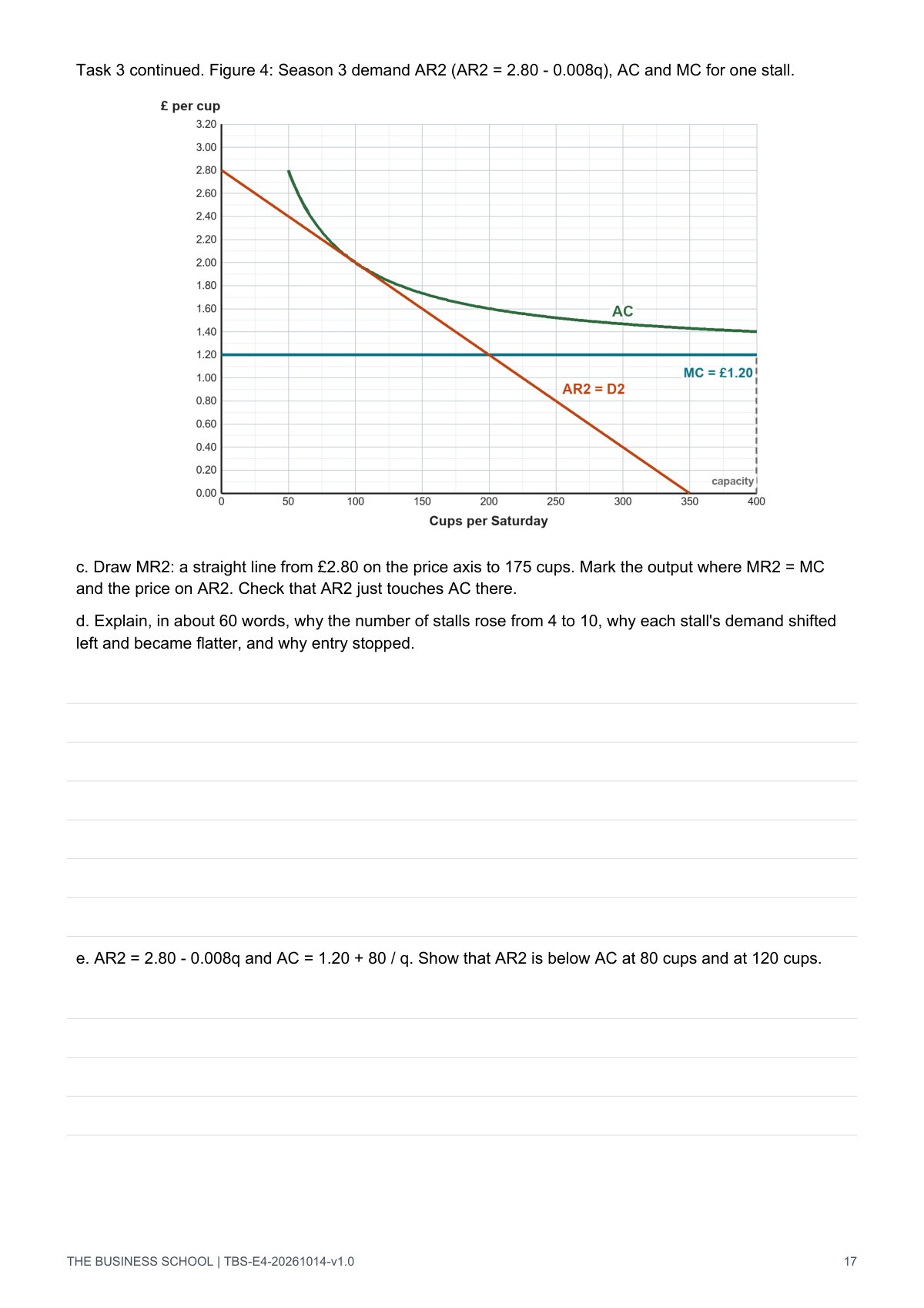
Lesson 1: a potato grower's cost table, the profit-maximising output at a price of 87 pounds, shut-down, and the short-run and long-run perfect competition diagrams with the market supply shift. Lesson 2: a coffee stall's demand and cost figures, marginal revenue, the profit-maximising output, and the short-run and long-run monopolistic competition diagrams (the tangency of demand and average cost). Lesson 3: a comparison of the two structures with figures (price against marginal cost, average cost against its lowest level), a test of a council limit on the number of stalls, and a written recommendation of about 180 words.
Each lesson plan counts the written work against the minutes, and the questions that do not fit are named as homework.
- Lesson1
How do potato growers compete?
A grower's cost table, the profit-maximising output at a price of 87 pounds, shut-down, short-run and long-run perfect competition diagrams with the market supply shift.
- Lesson2
Why do coffee stalls compete differently?
A stall's demand and cost figures, marginal revenue, the profit-maximising output, short-run and long-run monopolistic competition diagrams.
- Lesson3
Which market structure serves Orrelby better?
The two structures compared with figures, price against marginal cost, average cost against its lowest level, a test of a council limit on stalls, a 180-word recommendation.
| File | Pages | What it holds |
|---|---|---|
| Student workbook PDF Word | 24 (A4) | A three-page data pack, then every lesson's tasks with ruled answer space, figures to complete or mark, tables, exit tickets and the final recommendation. |
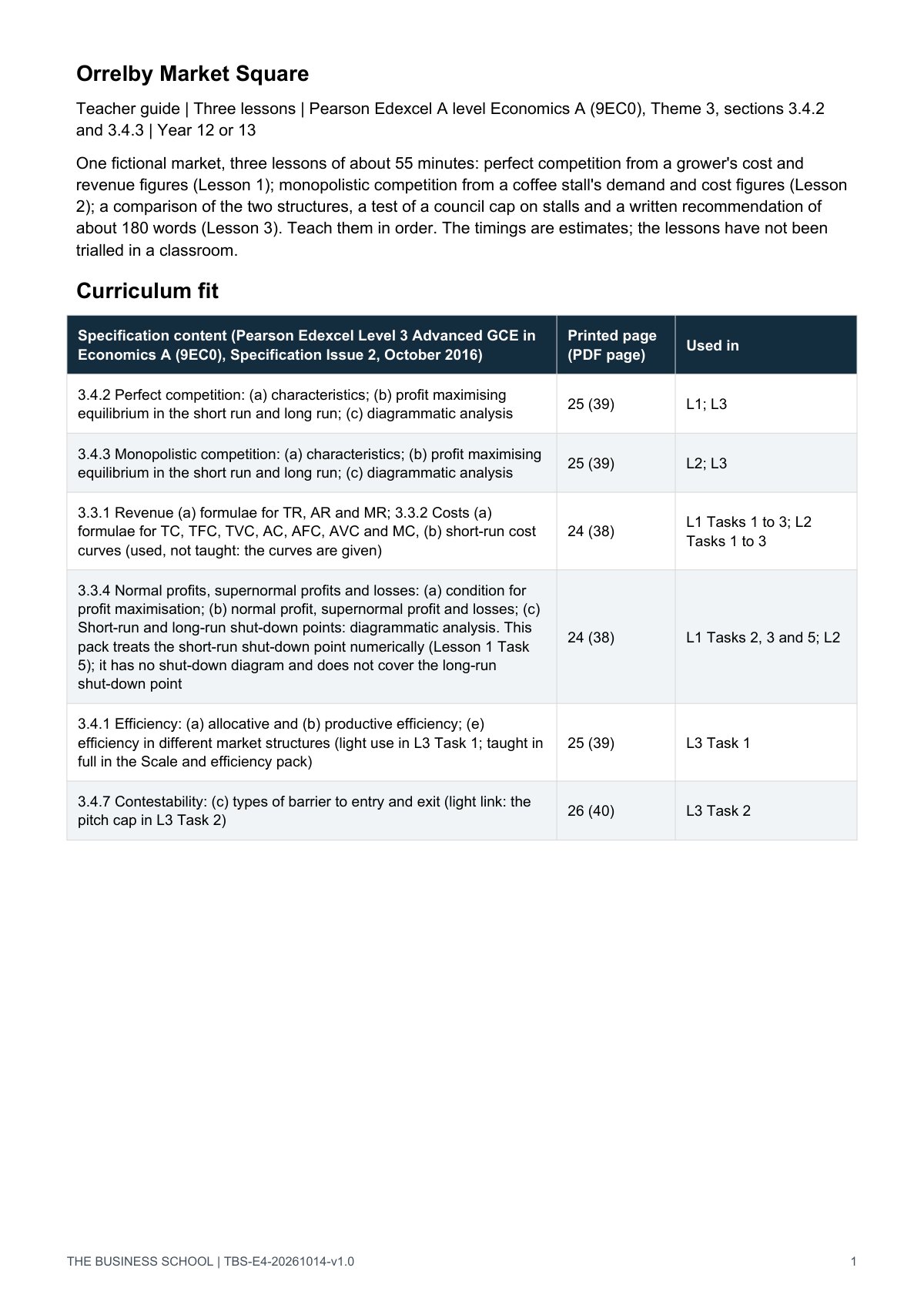
| Teacher guide PDF Word | 15 (A4) | Curriculum fit with page references, three 55-minute plans with homework rows, full worked answers, five completed figures, indicative guidance, support and stretch. |
Mapped to Pearson specification (Issue 2) sections 3.4.2 and 3.4.3, with 3.3.1, 3.3.2 and 3.3.4 used and 3.4.1 and 3.4.7 as light links.
Preview pages
Real pages from the files, at reading size. Click a page to open it full size.
About this pack
- New pack, no reviews yet. It is offered with the refund terms below.
- An original, fictional case. Every business, person, figure and quote is invented; nothing is real data.
- Timings are estimates. The lessons are not yet classroom-trialled.
- Written tasks come with indicative guidance and an example answer, not a mark scheme.
- The Word files were laid out and checked in LibreOffice, not Microsoft Word. Small layout differences are possible when you open them in Word.
- A classroom resource for teaching and practice. It does not replace a textbook or a scheme of work.
- Assumes students have already met the cost and revenue formulae, supply and demand and normal and supernormal profit.
- Written for Edexcel A level Economics A (9EC0), Theme 3, Business behaviour and the labour market, against the Pearson specification (Issue 2). Please check it against the specification you are teaching.
- Classroom teaching and practice only. It is not a Pearson set task and does not reproduce Pearson assessment materials.
- Not endorsed by Pearson. Contains no mark schemes.
Licence and refunds
One purchase licenses you and your school to use the pack with the students you teach: print it, project it, adapt the Word files for your own lessons and share it with colleagues in your department. Please do not post it publicly, upload it to resource-sharing sites or resell it.
If you are charged twice, cannot open the files, or the pack is not as described, email support@thebusiness.school and we put it right. Because the files are an immediate digital download and you lose the 14-day right to cancel when you buy, change-of-mind refunds are not offered once you have access. Your statutory rights are unaffected. The seller is TBS Education Ltd Oy; see the full terms and refund policy.
Who makes this

Writes the teaching material, runs the company and answers the support email himself.

Ten years teaching in Finnish vocational education.
Sold by TBS Education Ltd Oy, company number 3614159-3. About us
Questions
What exactly do I get?
A student workbook and a teacher guide for one original, fictional case. Both come as PDF and as editable Word files. The teacher guide has the lesson plans, full worked answers, completed diagrams and indicative guidance for the written tasks.
Can I edit the files?
Yes. The Word files are editable, so you can change the business name, the figures or the questions before you set it. They were laid out and checked in LibreOffice, not Microsoft Word, so you may see small layout differences in Word; the PDF is the reference layout. The download is a ZIP that opens on Windows and Mac without extra software.
Is it a mark scheme, and is it endorsed?
No to both. The teacher guide gives full answers for calculations and tables, and indicative guidance plus an example answer for each written task. It is not an exam board mark scheme, and the pack awards no marks or grades. It is mapped to the specification by section but is not endorsed by Pearson, and contains no exam board questions.
How does delivery work?
After payment you are sent straight to your download page and get a Stripe receipt by email. The download page is personal to your purchase; bookmark it.
What if something is wrong with my order?
Email support@thebusiness.school. The refund policy covers duplicate charges, files you cannot open and products that do not match their description.
Digital download. By buying you ask for immediate access to the files and acknowledge that you then lose the 14-day right to cancel. Refunds: see our refund page.