Built in Finland · Engineered for UK Classrooms
In professional partnership with our international engineering studio
The classroom simulation where students run real companies.
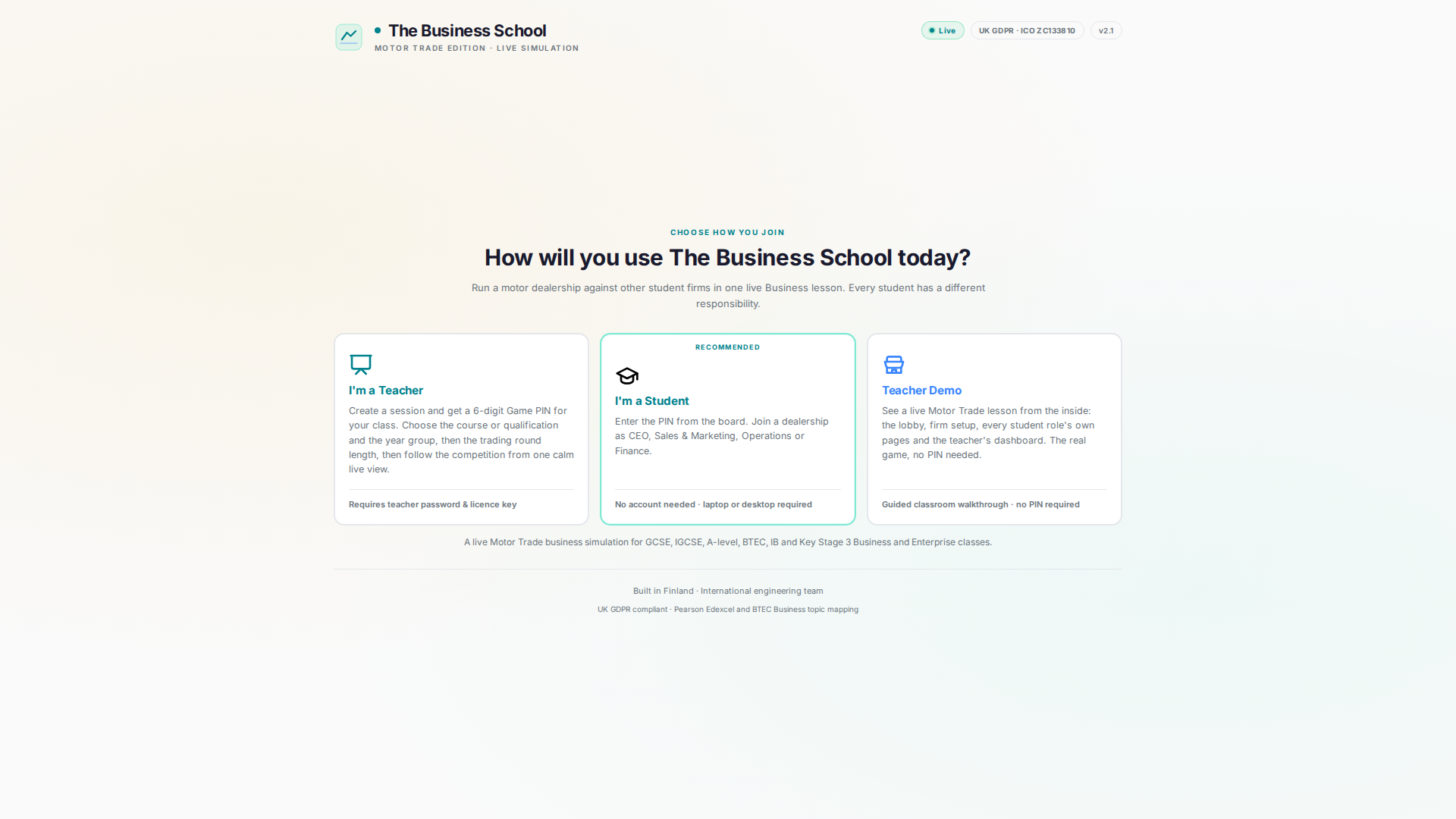
A live, multiplayer business simulation for UK A-Level, BTEC and IGCSE classrooms. Each student runs their own virtual firm — buying stock, setting retail prices, managing VAT, and reacting to teacher-triggered market events. Browser-only, no downloads, no student accounts — just a PIN.
Free Autumn 2026 pilot cohort opens 15 September. Edexcel theme-mapping build in development now.
No sign-up required. Demo opens in a new tab. Working pilot build available now — full release for pilot schools 15 September 2026.
How It Works
From session creation to student reports in four simple steps. No technical knowledge required.
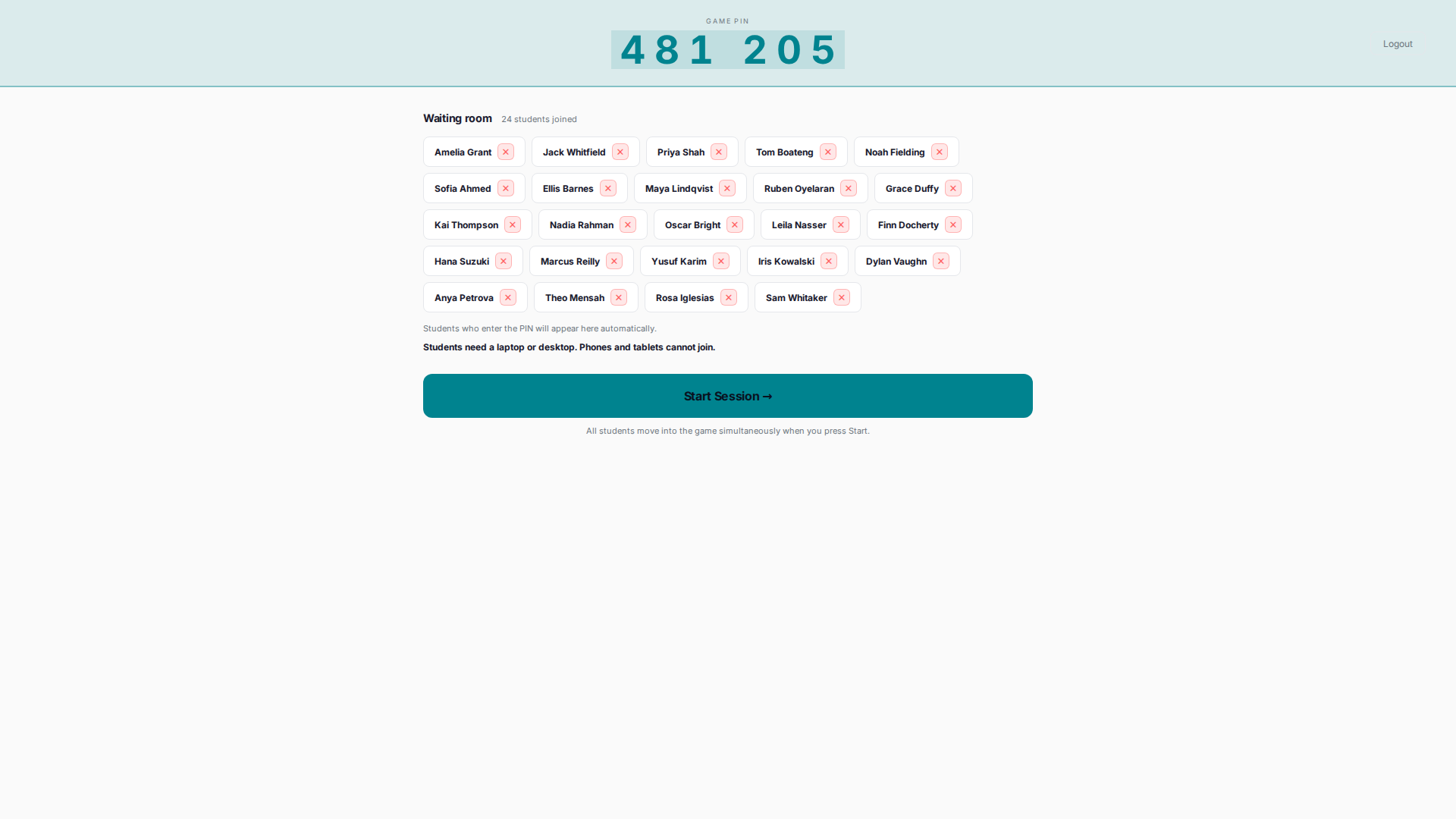
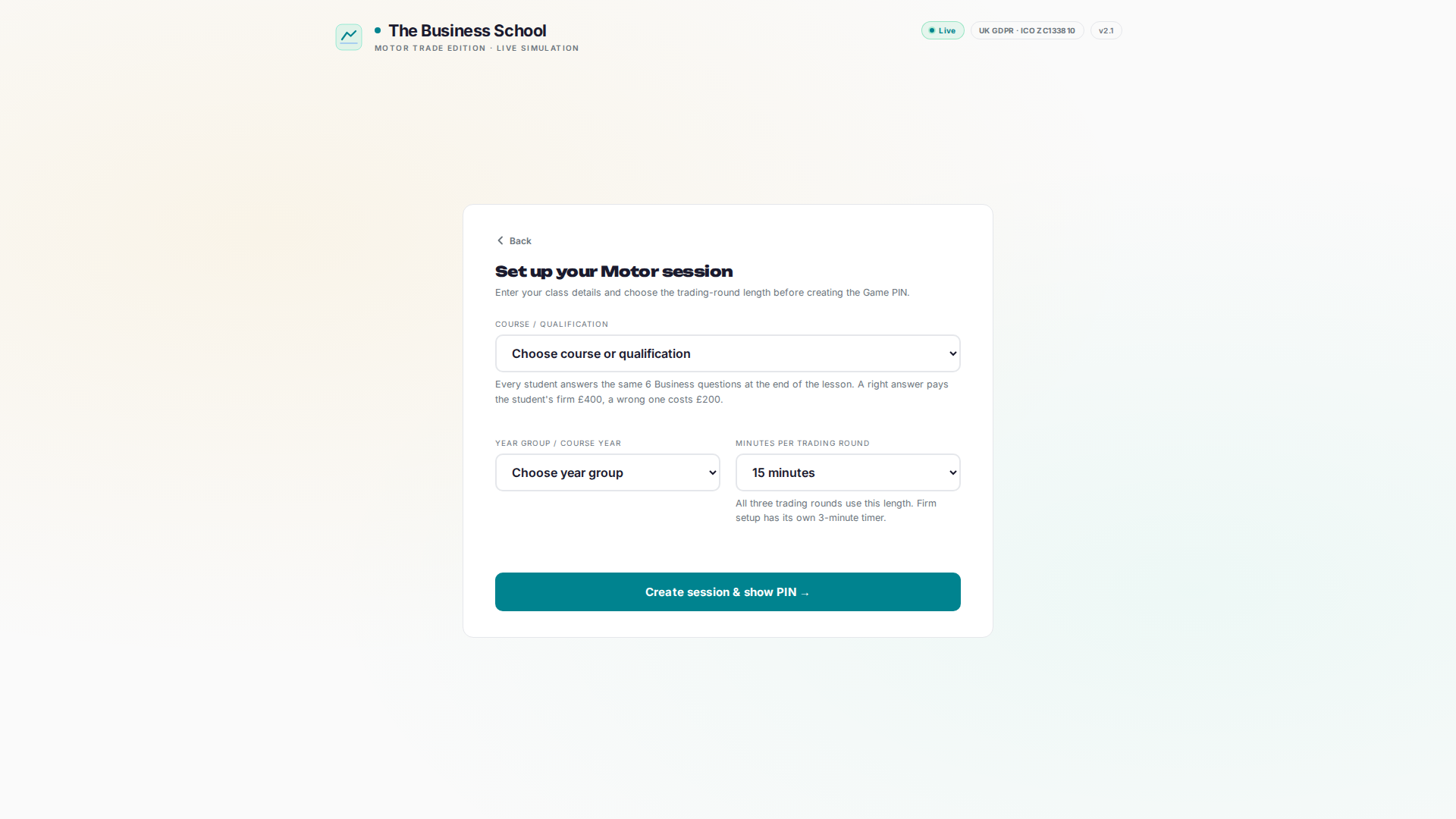
Log in with your teacher credentials and create a session. A unique 6-digit PIN and QR code are generated instantly.
Share the PIN with your class. Students join from any device — phones, tablets, laptops, Chromebooks. No app install, no student accounts required.
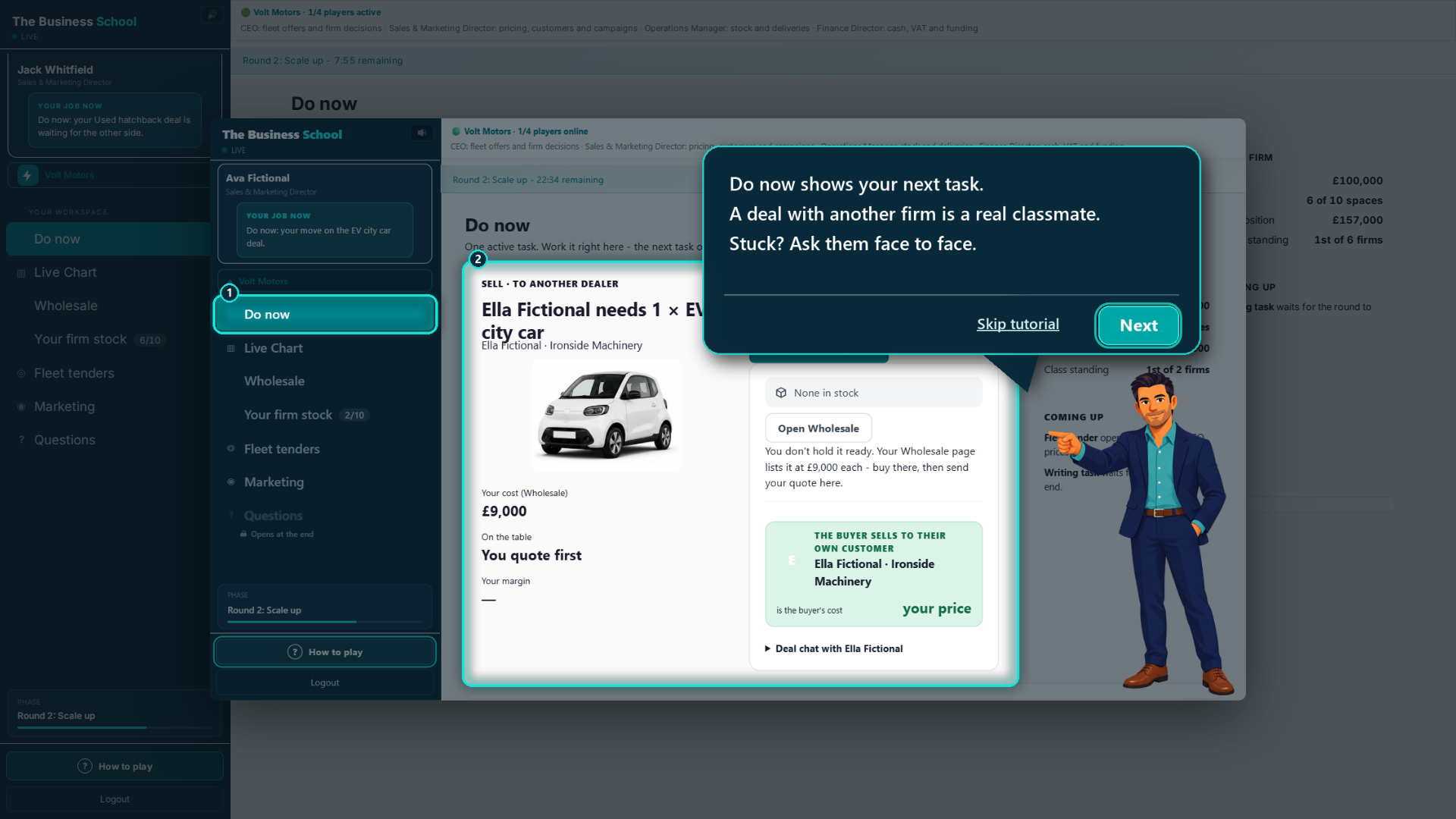
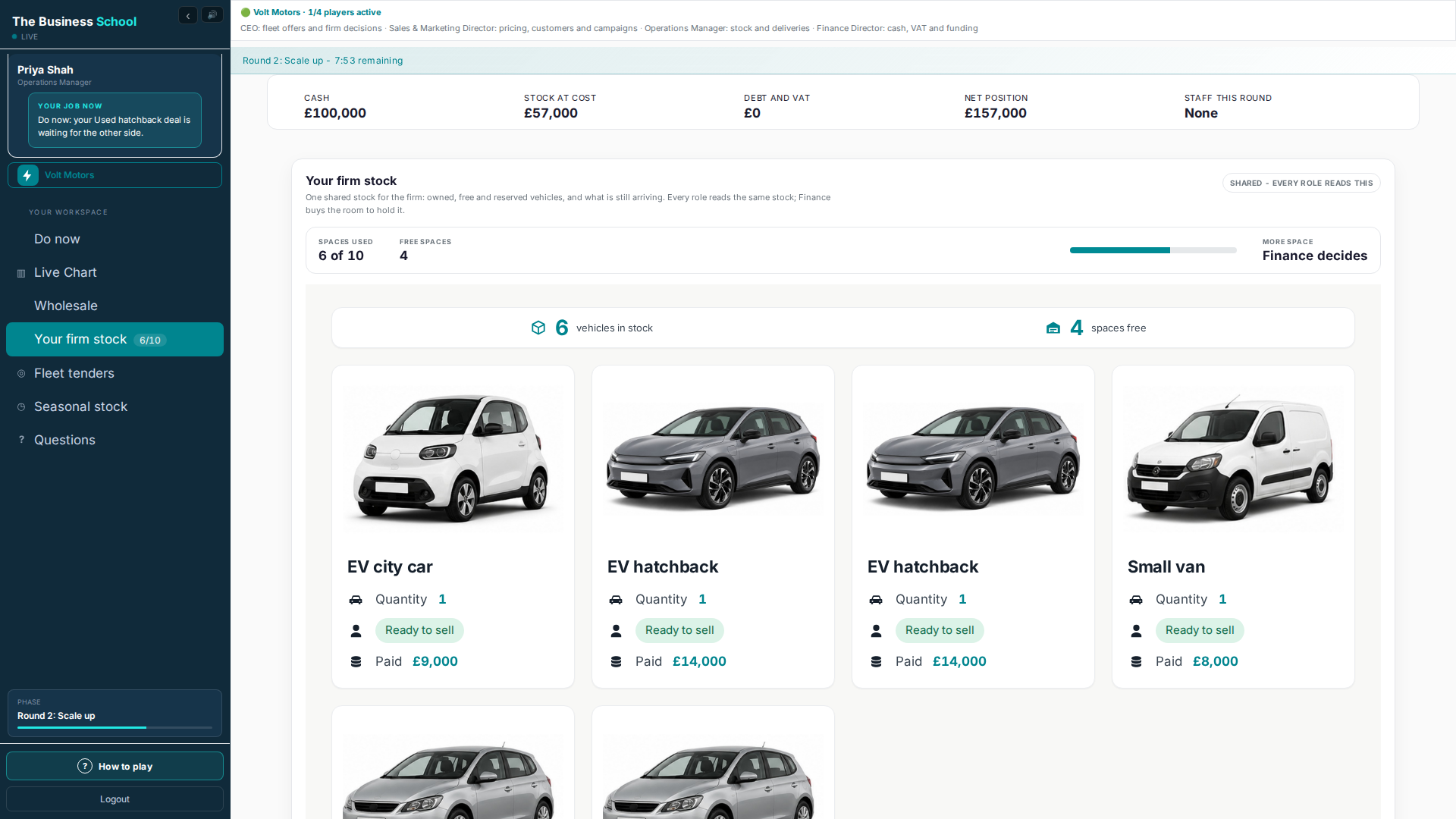
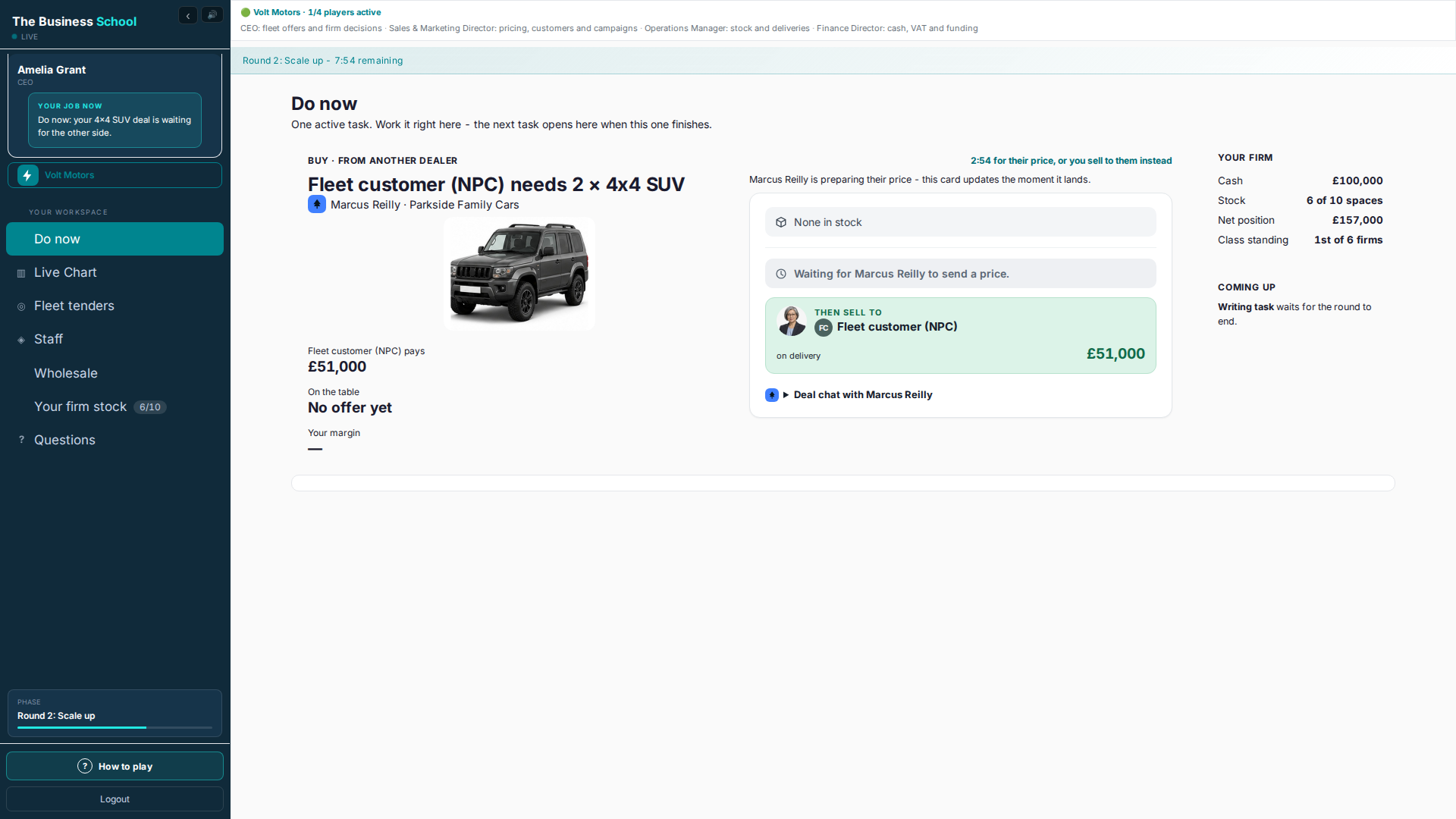
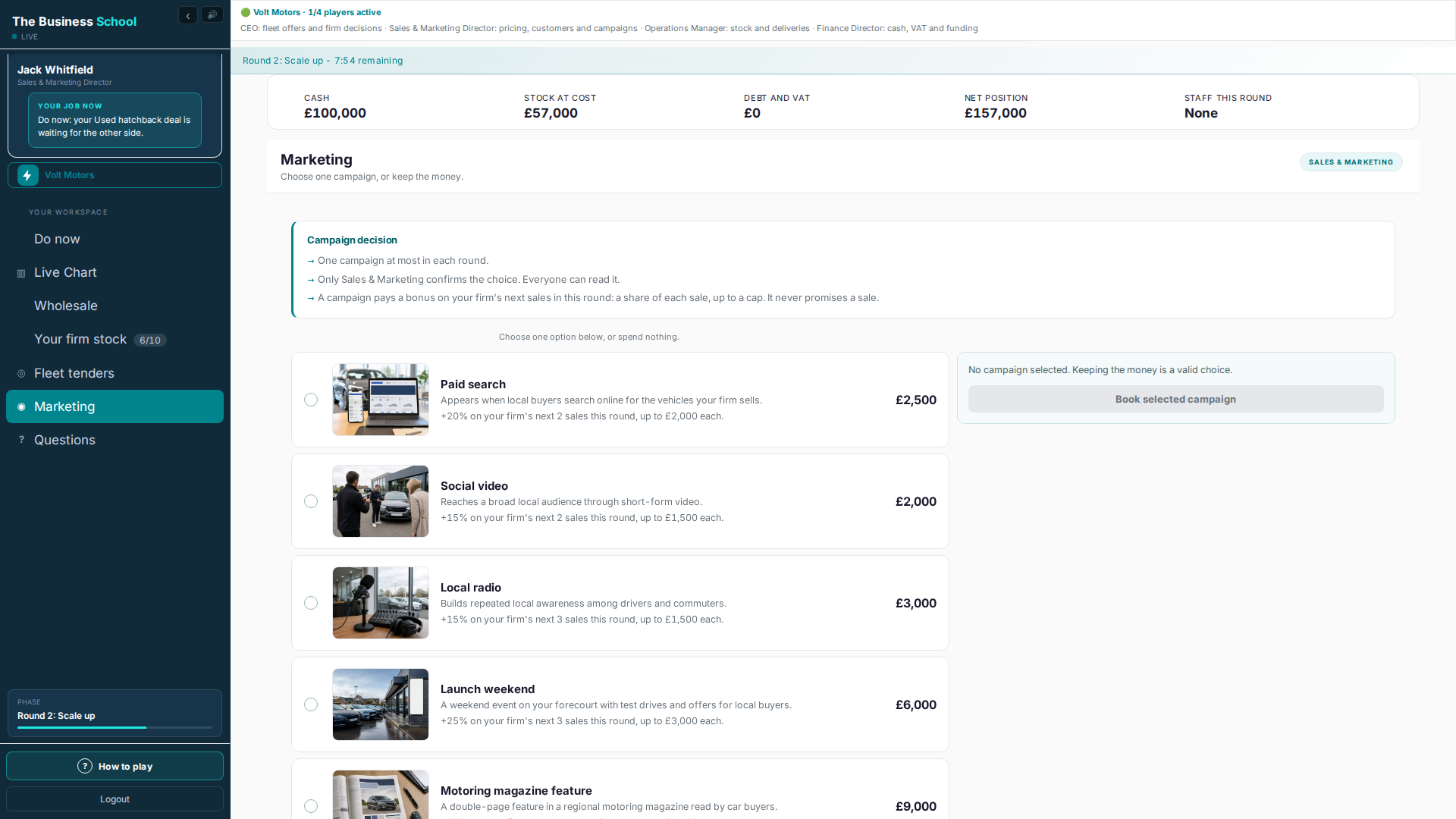
Students each run their own virtual firm — buying stock, setting retail prices, managing VAT. Control the pace, trigger crisis events, and monitor progress from the Teacher Dashboard.
After the session, every student receives an individual AI-generated performance report, a quiz covering the concepts they practised, and a printable certificate with their grade.
One session covers multiple specification topics. A flexible-length lesson — teacher controls pace, from 15-minute tutor slots to 60-minute deep dives — replaces weeks of textbook case studies with lived experience.
What Students Do
Each student manages their own virtual business — making real decisions with real financial consequences round after round.
Purchase from five product categories — Tech, Fashion, Food, Sports and Books — with a starting balance of £10,000.
Find the sweet spot between margin and volume. Price elasticity in action — over-price and demand drops, under-price and margin disappears.
Watch the sales log update each round. See which products are moving, which are stuck, and why.
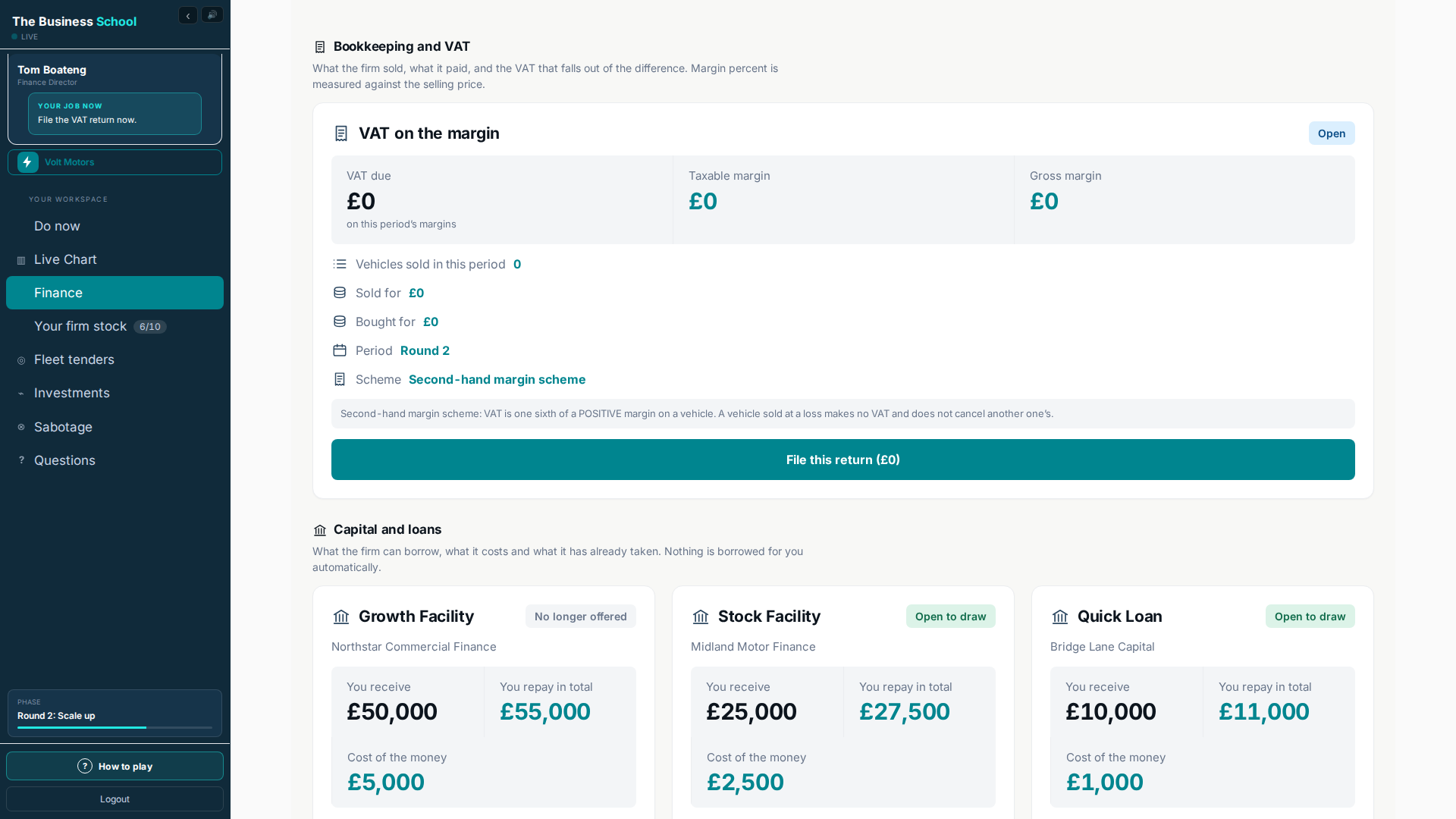
Track VAT collected, pay HMRC on time, and feel the cash-flow impact. Miss a return — lose points.
Supply Crisis, Demand Boom, Tax Hike, New Competitor, Viral Product, Recession — teacher-triggered events force strategic adaptation.
Capital, deals, quiz, VAT compliance and investment returns all contribute. Earn a UK grade (A* to U) and a Certificate of Achievement.
Every decision has real financial consequences. Students learn by experiencing the results of their choices — not by reading about someone else's.
Core Features
A flexible-length experience — 3 phases at any pace the teacher chooses (5-20 min each) — covering financial management, strategy, compliance, and decision-making.
Students list products, set prices, and compete for customers in real time. Pricing too high and customers go elsewhere. Pricing too low and margins suffer. This is price elasticity of demand — taught through direct experience.
Every transaction generates VAT. Students must file VAT returns to HMRC within the game. Late or incorrect filings incur penalties. Tax compliance as a practical skill, not an abstract concept.
Six scenario-based negotiation rounds where teams must reach agreements under pressure. Students practise stakeholder management, persuasion, and strategic compromise.
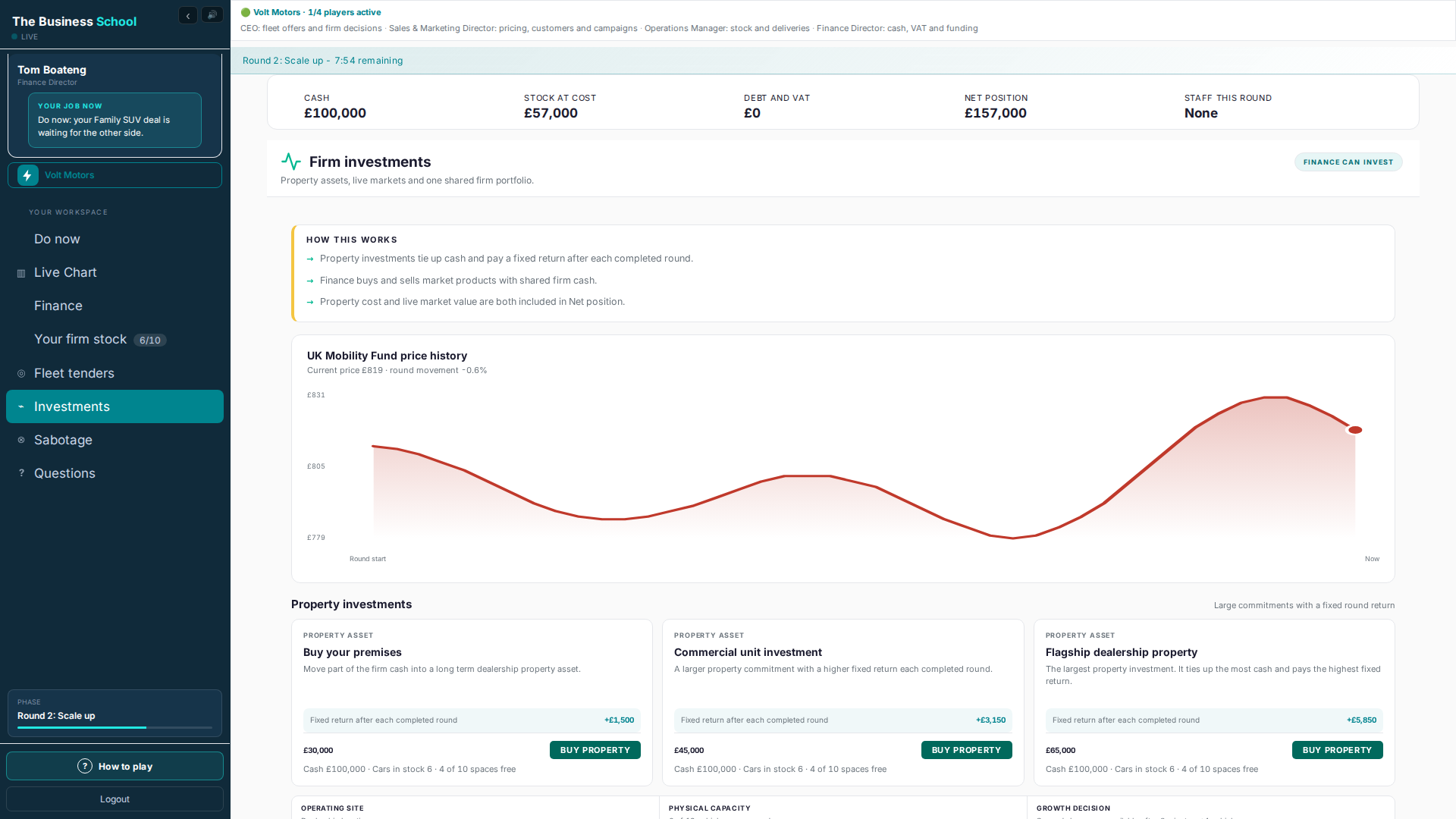
Students allocate capital to assets and manage their balance sheet. They experience the trade-off between liquidity and long-term growth.
Targeted challenges with cash rewards that guide teams toward specific learning objectives. Missions adapt to gameplay, keeping every student engaged regardless of their current position.
Inject real-world disruptions at any point: supply chain crises, demand booms, tax changes, new competitors, recessions, or viral product moments. Each crisis forces real-time strategic adaptation.
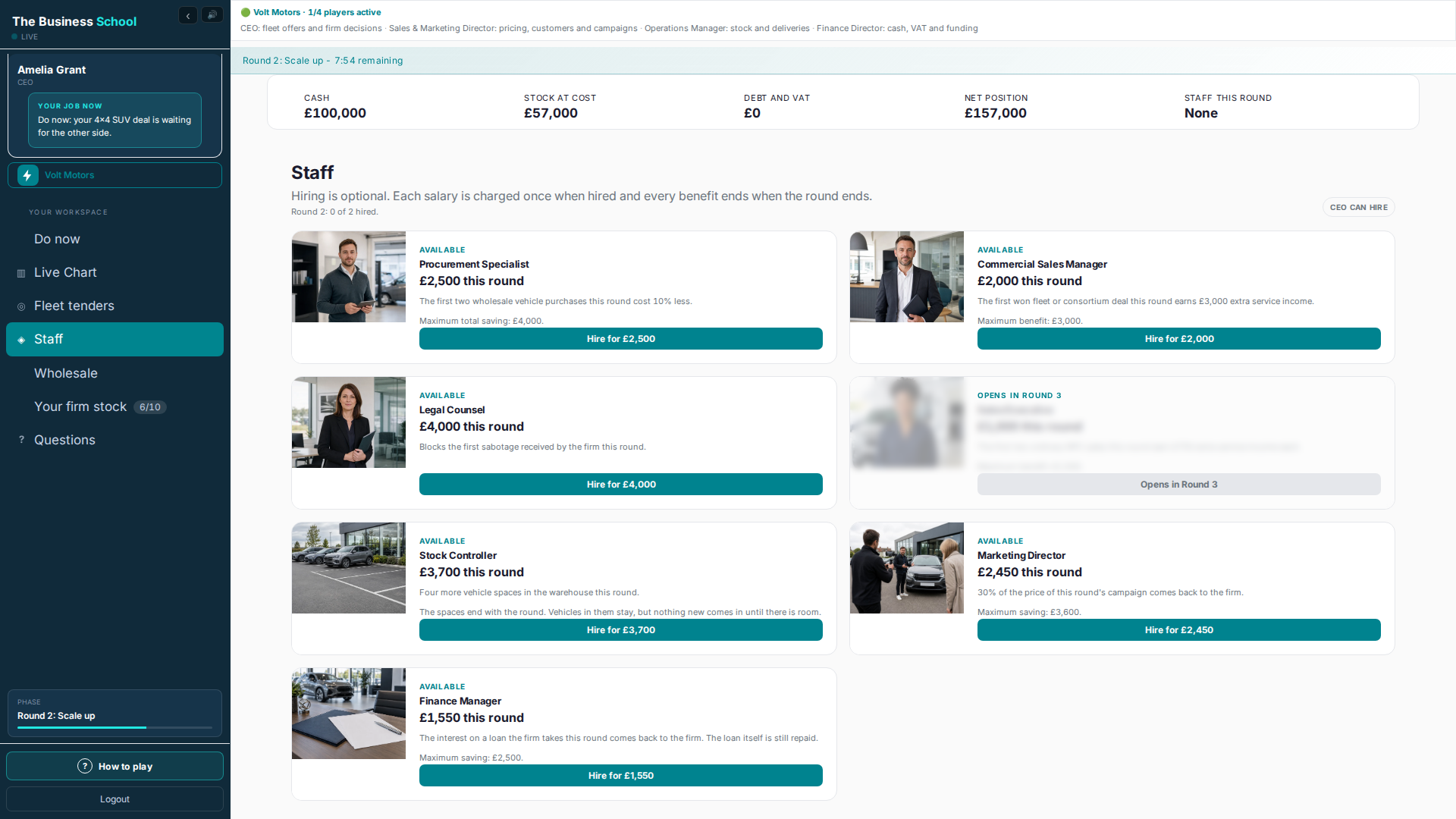
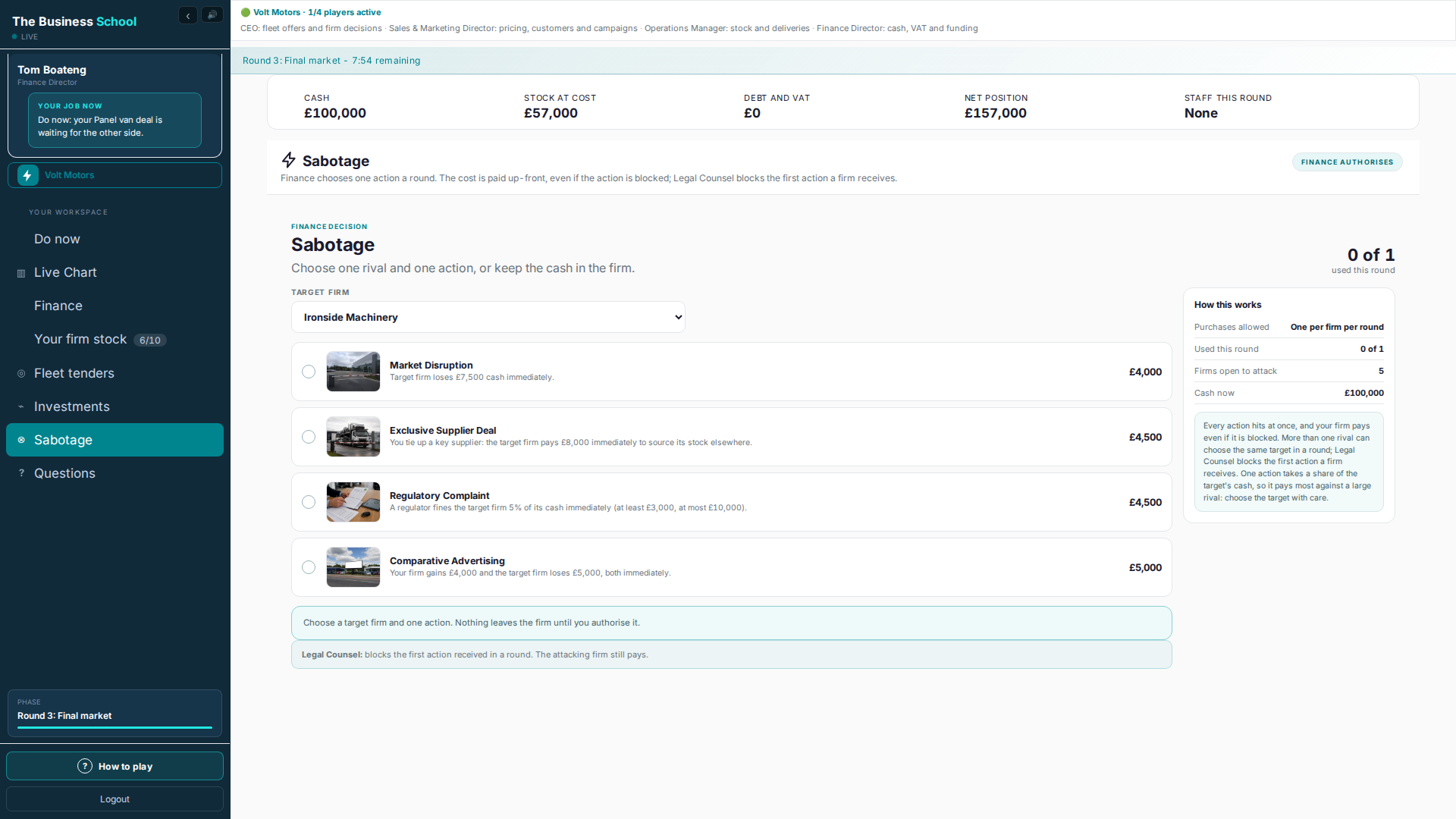
Recruit specialists to strengthen your company. Hire lawyers to shield your business from rival sabotage attempts, developers to create new products for the marketplace, and other professionals to gain a competitive edge. Every hiring decision affects your budget and strategy.
Deploy covert tactics against competing companies — disrupt their supply chains, poach their talent, or undermine their reputation. But beware: rivals can hire lawyers and take countermeasures. Strategic sabotage adds a layer of corporate rivalry that teaches risk assessment, ethics, and defensive business strategy.
Every student receives an individual report generated by AI, analysing their specific decisions, identifying strengths and areas for improvement, and mapping performance to curriculum topics.
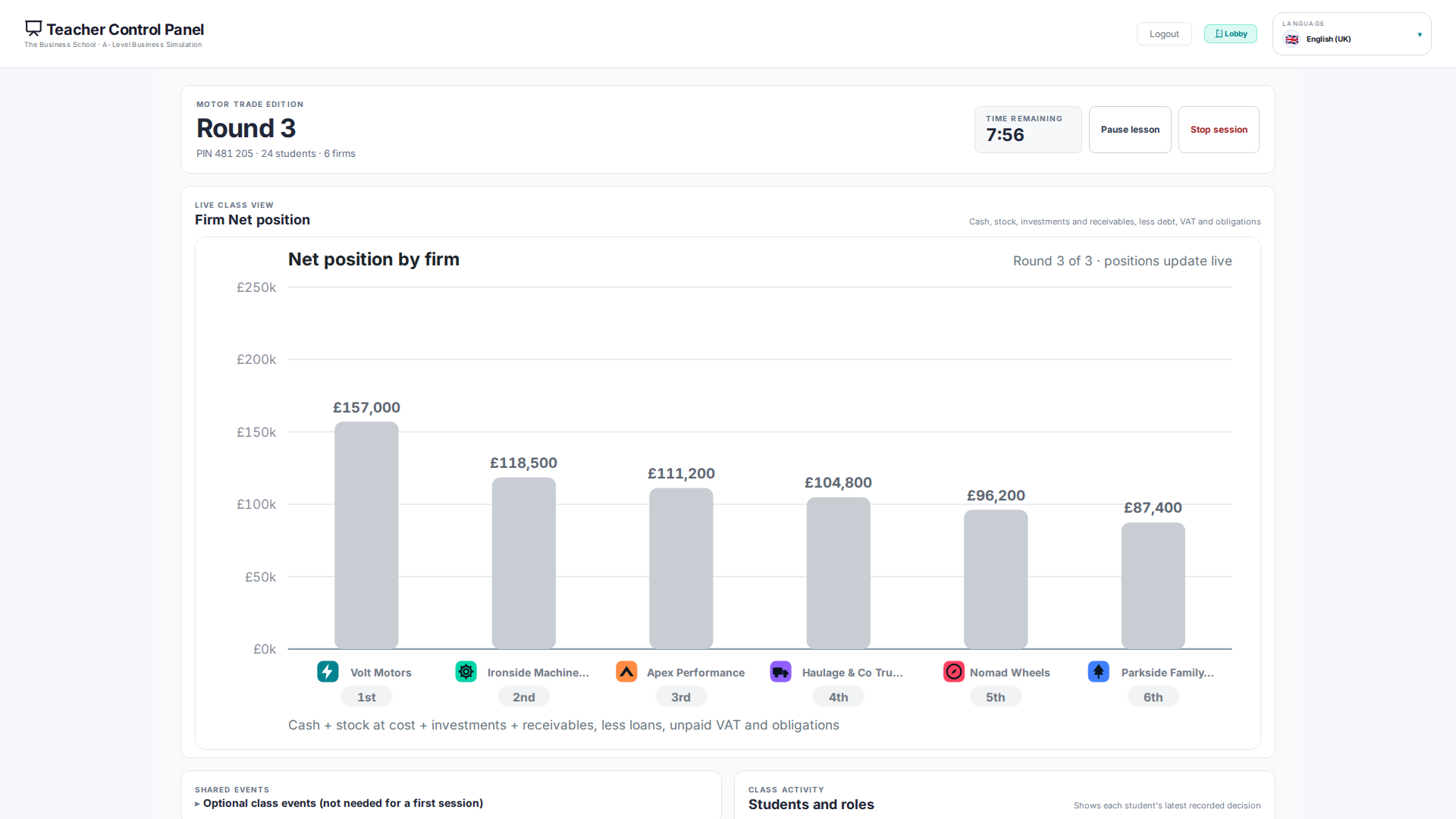
Real-time class rankings drive healthy competition. In-game chat enables team coordination and cross-company negotiation.
Every student receives a printable certificate with their grade (A* to U, mapped to the UK grading system), score, company name, and session details.
Personal Feedback
When the simulation ends, each student receives an AI-generated feedback report based on their actual decisions. Three things: what they did well, one area to improve, and encouragement to keep going. Not a generic score. Real, personalised insight into how they ran their business.
Specific decisions where the student excelled — pricing moves, negotiation wins, timely VAT filings, or smart investments.
A single, focused insight tied to an actual choice they made. Concrete and actionable — never a generic critique.
Personalised motivation that reflects their journey, written to build confidence and curiosity for the next session.
Curriculum Alignment
Every in-game decision maps to at least one specification topic. The post-game quiz and AI report explicitly reference the concepts each student encountered during play.
Topics 3.1 to 3.6 including business objectives, finance, marketing, operations, HR, and strategic decision-making.
Themes 1 through 4, covering marketing, managing people, business decisions, and global strategy.
All components including business operations, strategic management, and the competitive environment.
Units covering business finance, marketing, and enterprise.
Core and supplement topics across both AS and A Level syllabuses.
Covers organisational planning, finance, marketing, HR, and operations within the SL and HL syllabus.
Teacher Dashboard
Monitor, guide, and adapt the lesson in real time with a dedicated teacher interface.
Every student's balance, profit, rank, and activity status at a glance.
Inject market disruptions at the right teaching moment.
Freeze the game for whole-class discussion at any point.
Round-by-round talking points and discussion prompts.
Optimised display for classroom projection.
Download all class data after the session for records and reporting.
Technical Details
No IT department involvement required. Zero friction for teachers and students.
Works on any device with a modern browser. No downloads, plugins, or installations.
Students join with a PIN code. No email addresses, no passwords, no GDPR data collection from minors.
Sessions are managed server-side. Performance scales to 30+ simultaneous students per session.
Teachers can create a session and have students playing within 60 seconds.
Lightweight data usage, compatible with filtered school networks.
Development Roadmap
The Business School is expanding with new features and new markets.
Live multiplayer simulation with marketplace trading, VAT compliance, boardroom negotiations, investments, crisis events, AI reports, and certificates. Built for UK Sixth Form Business teachers, with a free Autumn 2026 pilot cohort opening Tuesday 15 September.
A B2B trading layer where companies buy and sell to each other, introducing supply chain economics, trade credit, and wholesale pricing strategy.
Competitive bidding for scarce resources and premium contracts. Students learn about market mechanisms, price discovery, and competitive advantage under scarcity.
An expanded version designed for undergraduate and postgraduate Business, Economics, and MBA programmes. Deeper financial modelling, extended multi-session campaigns, industry-specific scenarios, and integration with academic assessment frameworks. Currently in design phase, planned for 2027.
Localised versions for GCC, Southeast Asia, and European markets. Support for IGCSE, IB, and national curricula.
Built by Professionals
The Business School is a professionally developed product. The simulation engine, the live multiplayer architecture and the teacher dashboard were built in a cross-continental partnership with a dedicated software studio — not assembled by a single founder with an AI tool.
Product and pedagogy direction from Lahti, Finland. Full-stack engineering by our international software partner. A deliberate partnership that combines Nordic educational expertise with professional software development.
Scoped engineering phases M1–M5, each with its own spec, budget and QA. Delivered on schedule by our international engineering partner. The Edexcel theme-alignment build (M5) is in active development now — additional capital committed, live mid-June 2026 with 5 new sub-milestones including same-industry competitive pricing, 30-player team capacity, and Edexcel theme mapping across every decision UI.
Browser-based frontend, serverless backend on Netlify, Postgres database in the EU, AI reports via Anthropic Claude. A real production system that runs 30 concurrent students in a live classroom.
About
Built from a real lesson no classroom ever taught.
"At 17, I organised large-scale events, took real financial risks — and learned the hard way what happens when you miss a tax return."
That one mistake led to €8,400 in debt recovery. No teacher, no textbook, and no career advisor had ever mentioned that this could happen. It was a lesson no classroom had prepared me for.
A growing share of Gen Z students already run a side hustle by sixth form. Social media has made entrepreneurship feel easy — but nobody teaches the financial fundamentals that can make or break a young business.
That question — what if students could make those mistakes safely, before they cost real money? — became The Business School.
The Business School is proudly built in Finland — a country consistently ranked #1 in the world for education. Our pedagogy is founded on trust, equality, and learning by doing, and those principles are at the heart of everything we build. That foundation gives us a unique perspective on how students truly learn: not through theory alone, but through experience.
To build the simulation itself we partnered with Appifest, our international software engineering studio. The engineering work — the real-time multiplayer architecture, the teacher dashboard, the database layer, the AI-report pipeline — has been delivered milestone by milestone over the past year, with substantial development capital committed to a polished classroom-ready build now in active development. Each student runs their own competing firm. Across teacher-paced phases, they set prices, manage a VAT account, negotiate B2B contracts and respond to teacher-triggered crisis events. Every decision is tracked, mapped to the A-Level specification, and reflected in a per-team comparative report.
The platform is browser-based with zero IT setup. Students join with a PIN. Teachers click one button to start. We are running a free pilot cohort with UK Sixth Form schools in autumn 2026 (Pilot Day, Tuesday 15 September), with international expansion planned afterwards.
Frequently Asked
The questions UK Sixth Form teachers ask before running their first session. If yours is missing, email sakari.laajoki@gmail.com.
The teacher demo is free — no credit card, no email capture. The free Autumn 2026 pilot cohort opens on Pilot Day, Tuesday 15 September 2026. Paid tiers launch January 2027. Full details, including department, school-wide and MAT pricing, are on the Pricing page.
The simulation maps to Edexcel 9BS0 (Themes 1–4), AQA 7132 (marketing, finance and decision-making sections) and OCR H431 / H031. It also works for Pearson BTEC Level 3 Business (Unit 3 — Personal and Business Finance) and Cambridge IGCSE 0450 Business Studies. A University mode is built in for undergraduate taster sessions. Full mapping is on the Curriculum page.
No. Students join a session by typing a PIN and choosing a nickname. No email, no password, no personal data is collected from students. UK GDPR compliant by design — see the Trust Centre.
The simulation is fully flexible — teachers control phase length and overall pace. Typical structure is 3 phases (e.g. 5 min × 3, 15 min × 3, or 20 min × 3) but it adapts to whatever teaching slot you have, from a 15-minute tutor slot to a 60-minute deep lesson. End the session at any point using the End Game button.
Any device with a modern browser — Chromebook, laptop, tablet or phone. Each student uses one device. The teacher projects the dashboard from their own laptop. No apps to install, no IT department involvement required.
Up to 30 students per session. Students can play as individuals or be organised into teams of 3–5. Larger classes can be split across two parallel sessions with different PINs.
Yes. The game teaches through trial — students see the consequence of each decision within a round. The onboarding walks each student through every screen on first use. A SEND accessibility pack is in development (extended quiz timers 15 / 30 / 45 / 60 seconds, larger-text mode, dyslexia-friendly font) and ships in the polished classroom-ready build, mid-June 2026.
Yes — it is browser-based and works on standard UK school networks. If your school firewall blocks unknown domains, ask IT to allow thebusiness.school. The teacher dashboard has a pause control, so short Wi-Fi drops do not break the session.
Yes. The teacher controls the session from a dedicated dashboard: pause and resume rounds, trigger crisis events (Supply Crisis, Demand Boom, Tax Hike, New Competitor, Viral Product, Recession), advance rounds or end the game, and view real-time leaderboard and profit margins. A separate projector view is designed for whole-class display.
Yes. Students type a nickname — no real name, email or other personal data is collected. Sessions are ephemeral by default. Paid-tier teachers can save session data under their own account with full export and deletion rights. Data is hosted in the EU (Netlify + Neon, Frankfurt). Full documentation on the Trust Centre.
Got a question not answered here? Drop us a line →
Free pilot programme · Autumn 2026
13-week pilot of The Business School Simulation, Sept – Dec 2026. Cohort capped at 20 schools. UK A-Level, BTEC, IGCSE and IB Business.
Apply for the pilot →Or, for general questions — demo access, pricing, group licensing, partnerships — drop us a line:
Or email us directly: sakari.laajoki@gmail.com